PXRD Resources and Learning Centre
All users of the powder diffraction instruments are strongly encouraged to watch the sample preparation videos. Users found to be repeatedly using unsafe sample preparations despite warnings against doing so may face a ban from the facility. Correct sample preparations can be seen on the sample holders page.
Video resources are hosted on Panopto and require an Oxford SSO to access.
Sample preparation:
- The default preparation, using grease to attach a thin layer of powder to a surface
- An alternative preparation, packing the powder into a recession in the sample holder
- A description of when you might want to use one method or the other
Measurement considerations:
- Choosing which instrument to use
- Choosing which angular range, step size and count time to use
- Grazing Incidence
General information:
This is a template for the sample position when using the X'pert or Empyrean flat plate holder. Print out on A4 at 100% scale and place under a microscope slide then outline the sample area with marker pen to align your sample correctly.
This is a tool for calculating the beam cuttoff or overspill caused by the Bruker 'knife' for a given divergence slit setting (this tool was supplied by Bruker AXS).
This is a divergence calculator for the X'pert and Empyrean that tells you the illuminated length of sample for a fixed slit at a given angle, or what the divergence slit width will be for a fixed illumination length at a given angle.
This is a calculator for working out the ideal sample width, incidence angle, or incident slit width in a grazing incidence setup.
Bruker D8
A 22mm diameter glass slide with a thin coating of LaB6 NIST660C. Diffraction pattern taken using a constant divergence slit of 0.5 degree. 2.5 degree soller slits (change extension to .xy):
X'pert Alpha1
A panalytical silicon low background wafer coated with NIST660c LaB6. Diffraction pattern taken while spinning the sample with the standard slit settings: constant primary divergence slit of 0.5 degree, constant primary antiscatter slit of 1 degree, 10mm mask, 0.04 radian primary and secondary soller slits, a secondary antiscatter slit of 5 degrees, X'celerator detector 2.122 degree active length. (change extension to .xy)
A Borosilicate microscope slide coated with NIST640f silicon. Diffraction pattern taken in the flat bracket (without spinning) the sample with the standard slit settings: constant primary divergence slit of 0.5 degree, constant primary antiscatter slit of 1 degree, 10mm mask, 0.04 radian primary and secondary soller slits, a secondary antiscatter slit of 5 degrees, X'celerator detector 2.122 degree active length. (change extension to .xy)
Empyrean Alpha 1
A panalytical silicon low background wafer coated with NIST660c LaB6. Diffraction pattern taken while spinning the sample with the standard slit settings: constant primary divergence slit of 0.5 degree, constant primary antiscatter slit of 1 degree, 10mm mask, 0.04 radian primary and secondary soller slits, a secondary antiscatter slit of 1 degree, Pixcel 1D detector 3.3473 degree active length. (change extension to .xy)
A Borosilicate microscope slide coated with NIST640f silicon. Diffraction pattern taken in the flat bracket (without spinning) the sample with the standard slit settings: constant primary divergence slit of 0.5 degree, constant primary antiscatter slit of 1 degree, 10mm mask, 0.04 radian primary and secondary soller slits, a secondary antiscatter slit of 1 degrees, Pixcel 1D detector 3.3473 degree active length. (change extension to .xy)
An online tool for calculating the absorption in a capillary sample: Compute X-ray Absorption (anl.gov)
An attenuation length calculator: X-Ray Attenuation Length (lbl.gov)
Programs for converting powder diffraction data file formats: PowDLL (uoi.gr) and 11-BM Resources: The CMPR program (anl.gov)
Rigaku's XRD training courses: Training - XRD To access these you'll need the instrument serial number, which can be found on a sticker at the rear of the instrument (BD......-01), and the ICL's postcode.
Malvern Panalytical's Knowledge centre with technical and application notes: Malvern Panalytical's Knowledge Center | Malvern Panalytical and recorded training and sales events Malvern Events - Live Events, Recorded Events and User Training | Malvern Panalytical
A comprehensive set of notes on all things powder diffraction from Jeremy Cockcroft and Paul Barnes Course Material Master Index (ucl.ac.uk)
Structure refinement software: FullProf Suite Homepage (ill.eu) , EXPGUI - A Graphical User Interface for GSAS (anl.gov), GSAS-II - Crystallography Data Analysis Software (anl.gov) , Jana - Crystallographic Computing System (fzu.cz), TOPAS-Academic (paid)
Free Search-Match software compatible with the free COD: QualX (not personally tested out. Paid, licenced software for this is available within in the facility)
Topas Tutorials: Durham Topas Tutorials Wiki: Topas - Topas Wiki (dur.ac.uk) and Forum: Topas Forum (dur.ac.uk)
Cautionary note:
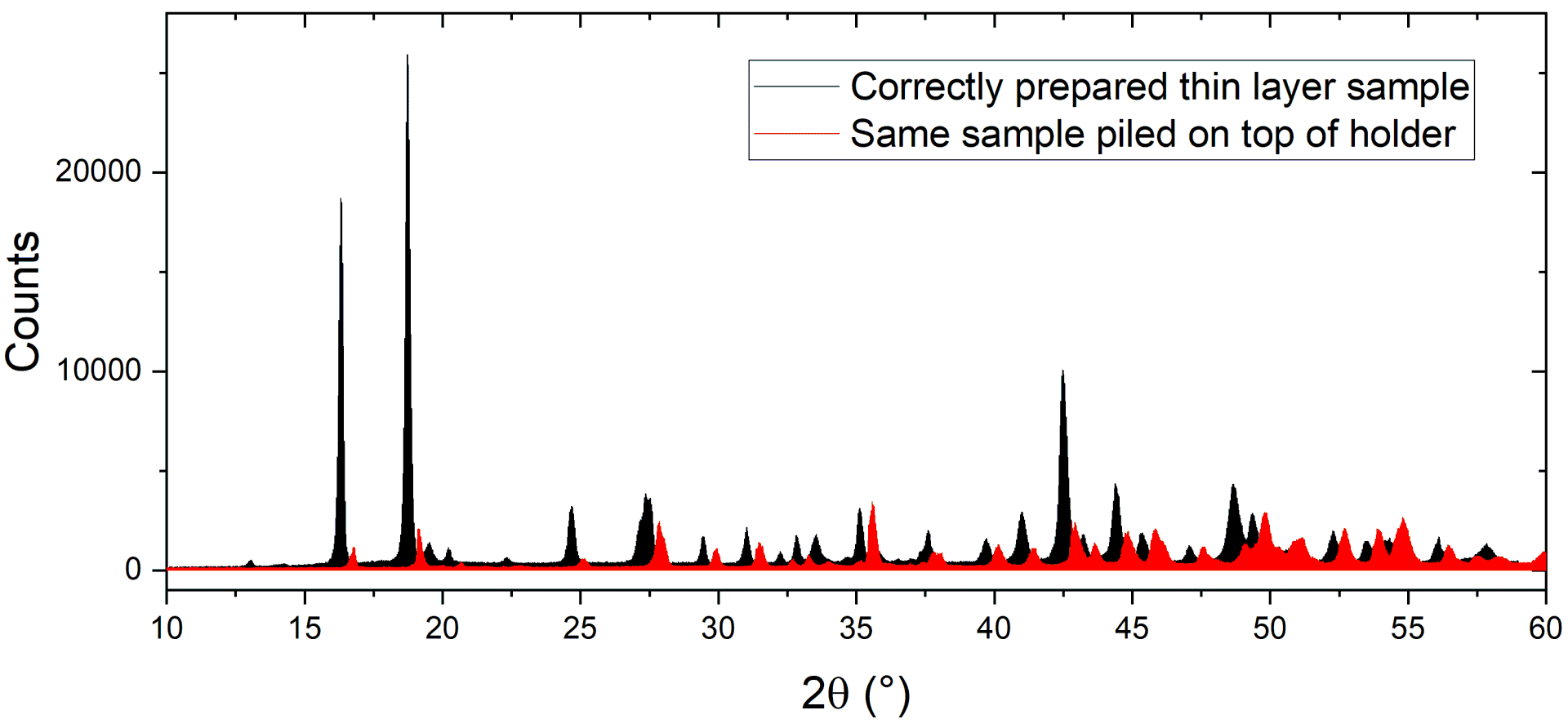
There are many reasons why a poorly prepared sample could give you a confusing diffraction pattern, beyond just those described in the videos. Here is an example of a pattern taken after the powder was correctly attached as a thin layer to the surface of a slide using vacuum grease, and a pattern taken when the powder was a loose pile atop the sample holder: